ARDMS AE-Adult-Echocardiography日本語対策 & AE-Adult-Echocardiography資格講座
Wiki Article
2026年CertJukenの最新AE-Adult-Echocardiography PDFダンプおよびAE-Adult-Echocardiography試験エンジンの無料共有:https://drive.google.com/open?id=1iaimnKsKKoELia4dxNYJm2yVnh7bPvDd
ARDMS認証に伴って、この認証の重要性を発見する人が多くなっています。最近仕事を探すのは難しいですが、AE-Adult-Echocardiography認証を取得して、あなたの就職チャンスを増加することができます。あなたは試験に合格したいなら、我々のAE-Adult-Echocardiography問題集を利用することができます。
ARDMS AE-Adult-Echocardiography 認定試験の出題範囲:
| トピック | 出題範囲 |
|---|---|
| トピック 1 |
|
| トピック 2 |
|
| トピック 3 |
|
| トピック 4 |
|
| トピック 5 |
|
>> ARDMS AE-Adult-Echocardiography日本語対策 <<
ARDMS AE-Adult-Echocardiography資格講座、AE-Adult-Echocardiography勉強方法
AE-Adult-Echocardiography学習クイズの合格率は99%で、AE-Adult-Echocardiography実践ガイドは高いヒット率を高めます。当社のAE-Adult-Echocardiographyテストトレントは専門家によって編集され、ARDMS提供される回答と質問は実際の試験に基づいています。AE-Adult-Echocardiography試験問題の内容は、理解して習得するのが簡単です。試験の準備を万全にするために、当社のソフトウェアは、実際の試験を刺激する機能と、速度の調整に役立つタイミング機能を提供します。AE-Adult-Echocardiographyガイド急流のこれらのメリットに基づいて、AE-Adult-Echocardiography試験に高い確率で合格できます。
ARDMS AE Adult Echocardiography Examination 認定 AE-Adult-Echocardiography 試験問題 (Q76-Q81):
質問 # 76
Which condition is commonly associated with cardiac tamponade?
- A. Hypertension
- B. Hypotension
- C. Bradycardia
- D. Decreased jugular venous pressure
正解:B
解説:
Comprehensive and Detailed Explanation From Exact Extract:
Cardiac tamponade occurs when fluid accumulation in the pericardial space increases intrapericardial pressure, restricting ventricular filling and reducing cardiac output. A hallmark clinical feature is hypotension due to decreased stroke volume and cardiac output.
Jugular venous pressure is typically elevated (not decreased) because of impaired right heart filling.
Tachycardia, not bradycardia, is usually present as a compensatory response. Blood pressure tends to be low or normal, not hypertensive.
This pathophysiology and clinical presentation are well documented in adult echocardiography literature and clinical cardiology textbooks, where tamponade is diagnosed with signs such as right atrial and ventricular diastolic collapse and associated clinical hypotension and elevated venous pressures#16:Textbook of Clinical Echocardiography, 6ep.280-285##12:ASE Pericardial Disease Guidelinesp.300-305#.
質問 # 77
The sonographer obtains this Doppler signal while using the non-imaging transducer in the apical position.
What is the best way to differentiate between mitral regurgitation and aortic stenosis signals in the waveform shown in this image?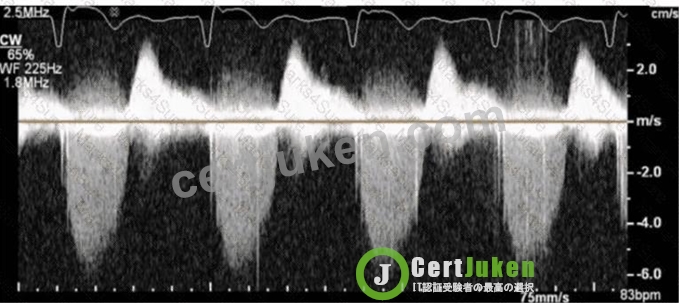
- A. Aortic stenosis velocities will always be higher
- B. Mitral regurgitation signal will be longer
- C. Mitral regurgitation only happens in diastole
- D. Aortic stenosis waveforms will always be denser
正解:B
解説:
Comprehensive and Detailed Explanation From Exact Extract:
Mitral regurgitation (MR) Doppler signals tend to be longer in duration because MR occurs throughout systole, often spanning most or all of ventricular systole, resulting in a prolonged jet on continuous wave Doppler.
Aortic stenosis (AS) velocities can be high but may vary and are not necessarily always higher than MR velocities. The density of waveforms is not a reliable discriminator. MR only happens in systole, not diastole, which makes option C incorrect.
Therefore, the duration or length of the Doppler signal (longer for MR) is the best differentiating feature.
This differentiation is explained in the "Textbook of Clinical Echocardiography, 6e", Chapter on Doppler Assessment of Valvular Disease#20:320-325Textbook of Clinical Echocardiography#.
質問 # 78
What is the range of the aortic valve area in normal adults?
- A. 1 - 2 cm2
- B. 5 - 6cm2
- C. 7- 8cm2
- D. 3 - 4cm2
正解:D
解説:
Comprehensive and Detailed Explanation From Exact Extract:
The normal aortic valve area (AVA) in adults typically ranges from 3 to 4 cm². This measurement is important for assessing aortic stenosis severity; values below this range suggest valve narrowing.
AVA values of 1-2 cm² indicate mild to moderate stenosis, while less than 1 cm² reflects severe stenosis.
Larger areas like 5-6 or 7-8 cm² are not physiologically typical.
This normal range is documented in the "Textbook of Clinical Echocardiography, 6e", Chapter on Aortic Valve Anatomy and Function#20:360-365Textbook of Clinical Echocardiography#.
質問 # 79
Which congenital abnormality is most consistent with the findings in this video?
- A. Eisenmenger syndrome
- B. Ventricular septal defect
- C. Ebstein anomaly
- D. Patent foramen ovale
正解:C
解説:
The video shows an apical four-chamber or subcostal echocardiographic view demonstrating a markedly enlarged right atrium with atrialization of part of the right ventricle, displacement of the tricuspid valve septal leaflet downward into the RV cavity, and severe tricuspid regurgitation. These findings are hallmark features of Ebstein anomaly, a congenital malformation of the tricuspid valve causing apical displacement of the septal and posterior leaflets.
Patent foramen ovale and ventricular septal defects have different echocardiographic features without tricuspid leaflet displacement. Eisenmenger syndrome refers to advanced pulmonary hypertension due to shunts but is not a specific congenital structural abnormality.
These diagnostic criteria and echocardiographic hallmarks are described in adult congenital heart disease literature and echocardiography textbooks#16:Textbook of Clinical Echocardiography, 6ep.570-575##12:
ASE Adult Congenital Guidelinesp.400-405#.
質問 # 80
Which statement is most accurate regarding cardiac contusion?
- A. It is focal ventricular hypertrophy.
- B. It can result from a myocardial infarction.
- C. It leads to hypercontractility of the left ventricle
- D. It affects the right ventricle more commonly than the left.
正解:D
解説:
Cardiac contusion is a myocardial injury resulting from blunt chest trauma, typically affecting the right ventricle more commonly than the left ventricle because of its anterior location and proximity to the chest wall. The injury can range from mild bruising to severe myocardial damage and dysfunction.
It does not result from myocardial infarction (which is ischemic injury), nor does it cause hypertrophy or hypercontractility. Instead, it may cause wall motion abnormalities, arrhythmias, or even rupture.
These features are detailed in echocardiography and trauma cardiology literature, including the "Textbook of Clinical Echocardiography" and clinical guidelines on blunt cardiac injury#16:Textbook of Clinical Echocardiography, 6ep.600-605##12:ASE Trauma Cardiology Guidelinesp.500-505#.
質問 # 81
......
ARDMSのAE-Adult-Echocardiography試験準備は、テストヒット率が高いため、98%〜100%の合格率です。 したがって、当社のAE-Adult-Echocardiography学習教材は効果的であるだけでなく、有用でもあります。 誰もが知っているように、時間は誰にとっても非常に重要です。 一部の候補者は、自分の仕事や家族で非常に忙しいです。 AE-Adult-Echocardiography試験の審査に時間をかけることは非常に困難です。 ただし、AE-Adult-Echocardiography試験の教材を使用する場合、学習する時間はほとんどなく、AE Adult Echocardiography Examination合格率は高くなります。 AE-Adult-Echocardiography学習教材はあなたの信頼に値します。
AE-Adult-Echocardiography資格講座: https://www.certjuken.com/AE-Adult-Echocardiography-exam.html
- 完璧なAE-Adult-Echocardiography日本語対策 - 合格スムーズAE-Adult-Echocardiography資格講座 | 一生懸命にAE-Adult-Echocardiography勉強方法 ???? 検索するだけで▛ www.shikenpass.com ▟から⇛ AE-Adult-Echocardiography ⇚を無料でダウンロードAE-Adult-Echocardiography一発合格
- 試験の準備方法-効率的なAE-Adult-Echocardiography日本語対策試験-真実的なAE-Adult-Echocardiography資格講座 ???? 今すぐ[ www.goshiken.com ]で⏩ AE-Adult-Echocardiography ⏪を検索し、無料でダウンロードしてくださいAE-Adult-Echocardiography受験資料更新版
- AE-Adult-Echocardiography試験の準備方法|検証するAE-Adult-Echocardiography日本語対策試験|最新のAE Adult Echocardiography Examination資格講座 ???? ➤ jp.fast2test.com ⮘に移動し、《 AE-Adult-Echocardiography 》を検索して無料でダウンロードしてくださいAE-Adult-Echocardiography日本語試験対策
- 公認されたARDMS AE-Adult-Echocardiography: AE Adult Echocardiography Examination日本語対策 - ハイパスレートGoShiken AE-Adult-Echocardiography資格講座 ???? ➽ AE-Adult-Echocardiography ????の試験問題は《 www.goshiken.com 》で無料配信中AE-Adult-Echocardiography復習対策書
- AE-Adult-Echocardiography試験の準備方法|検証するAE-Adult-Echocardiography日本語対策試験|最新のAE Adult Echocardiography Examination資格講座 ???? 最新▛ AE-Adult-Echocardiography ▟問題集ファイルは➽ www.goshiken.com ????にて検索AE-Adult-Echocardiography関連試験
- 試験ARDMS AE-Adult-Echocardiography日本語対策 - 一番優秀なAE-Adult-Echocardiography資格講座 | 大人気AE-Adult-Echocardiography勉強方法 ???? 「 www.goshiken.com 」は、✔ AE-Adult-Echocardiography ️✔️を無料でダウンロードするのに最適なサイトですAE-Adult-Echocardiography再テスト
- 更新する-一番優秀なAE-Adult-Echocardiography日本語対策試験-試験の準備方法AE-Adult-Echocardiography資格講座 ???? 《 www.topexam.jp 》にて限定無料の“ AE-Adult-Echocardiography ”問題集をダウンロードせよAE-Adult-Echocardiography模擬トレーリング
- AE-Adult-Echocardiography日本語試験対策 ???? AE-Adult-Echocardiography資格専門知識 ???? AE-Adult-Echocardiography資格専門知識 ???? { www.goshiken.com }に移動し、⇛ AE-Adult-Echocardiography ⇚を検索して無料でダウンロードしてくださいAE-Adult-Echocardiography無料サンプル
- 素晴らしいAE-Adult-Echocardiography日本語対策 | 最初の試行で簡単に勉強して試験に合格する - 正確的なARDMS AE Adult Echocardiography Examination ???? 時間限定無料で使える「 AE-Adult-Echocardiography 」の試験問題は“ www.goshiken.com ”サイトで検索AE-Adult-Echocardiography専門知識
- AE-Adult-Echocardiography再テスト ⬜ AE-Adult-Echocardiography模擬対策 ???? AE-Adult-Echocardiography専門知識 ???? ⇛ www.goshiken.com ⇚に移動し、➠ AE-Adult-Echocardiography ????を検索して、無料でダウンロード可能な試験資料を探しますAE-Adult-Echocardiography模擬対策
- AE-Adult-Echocardiography試験時間 ???? AE-Adult-Echocardiography専門知識 ???? AE-Adult-Echocardiography模擬対策 ???? ⮆ www.topexam.jp ⮄で⮆ AE-Adult-Echocardiography ⮄を検索して、無料でダウンロードしてくださいAE-Adult-Echocardiography模擬対策
- hannabtzd042614.national-wiki.com, ticketsbookmarks.com, shaniaugom301693.blog-gold.com, socialrator.com, bookmarkja.com, www.188ym.cc, murrayrlxz861997.daneblogger.com, jasperpskw628021.thebindingwiki.com, geralduxen590667.wiki-racconti.com, nettielebu061150.goabroadblog.com, Disposable vapes
BONUS!!! CertJuken AE-Adult-Echocardiographyダンプの一部を無料でダウンロード:https://drive.google.com/open?id=1iaimnKsKKoELia4dxNYJm2yVnh7bPvDd
Report this wiki page